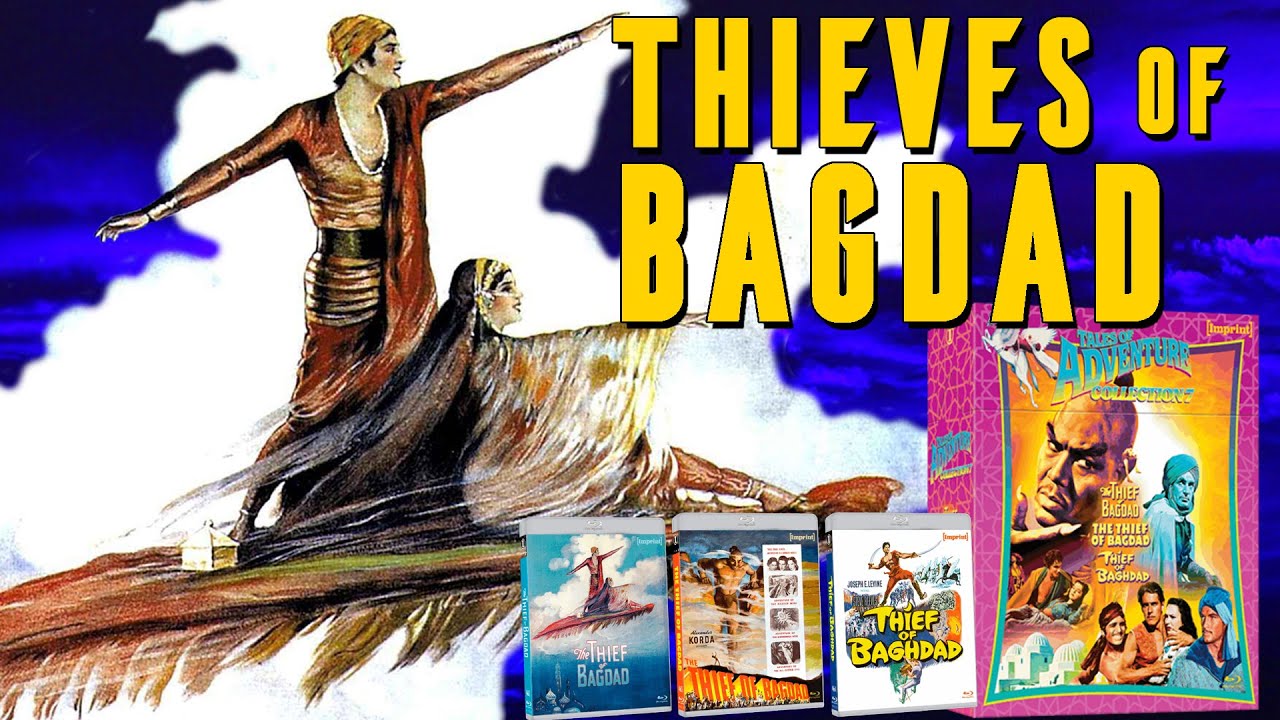
Welcome back to Dark Corner's physical media reviews. We're looking at Imprint's new Thief of Baghdad box set on Blu-ray, number seven in their Tales of Adventure series. Three takes on the Arabian Knights inspired tale from 1924, 1940, and 1961.
The Douglas Fairbanks original is arguably the apex of the stars light-hearted action adventure films. Epic in every way with some of the largest and most spectacular sets ever constructed for a film alongside flying horses, magic ropes, dragons, living trees, and a city of mermaids. No stop has gone unpulled, but it's not them we're here to see. Douglas Fairbanks was not a great actor, but what a star, what a performer, and what a scream presence, bounding joyously through the film. This scene sums up Fairbanks to me. Any excuse for a handstand. And yet he has a proper character arc too. His philosophy is exactly the same as the bad guys. But Ahmed the Thief learns and changes. Without Fairbanks, the film would be a slog. At 2 and a half hours, it is too long and loses focus in the second half. You might recognize this scene from the 1940 version, but here it's not the thief. He's off elsewhere. There's so much to get through that good scenes like this are wasted. When the princess is dying, it's not Fairbanks rushing to save her. It's the other princes. One of them poisoned her, but still. It is flawed, but thanks to Fairbanks, it's also tremendous. And the definition of they don't make them like that anymore. CGI has made us numb to vast scale on screen, but this still has the power to take your breath away.
All that said, the 1940 remake produced by Alexander Corder is even better. If it doesn't have Fairbanks, then Sabu is almost his equal in charisma. And while the silence does feel overblown, this is perfectly paced and retains its focus while not losing its fantasy spectacle. Also, Conrad Vite is cinema's greatest evil sorcerer.
As I said in our streaming review of this, for me, it sings of childhood. So perhaps that's why it's my favorite of this trio. I can't separate it from how it made me feel as a kid, but I do genuinely think that it's the one that best captures the escapism of fantasy. It takes you to an unreal world, but it's also a cracking adventure with a great story, memorable characters, and real heart.
All the more surprising for the fact that this was a troubled production that went through six directors and started out as a musical. We also have the 1961 version from Italy starring former Mr. Universe Steve Reeves in the title role. Part of the run of Sword and Sandle films Reeves made in the 60s. This version is closest to the Fairbanks film box ticking the flying horse, living trees, invisibility cloak, city of nymphs, amongst others, and actually improves on that film in that the quest is to save the princess's life.
Only one remedy may save your daughter. Only a blue rose. Other than that, this is a much watered down take. Reeves Karim starts as a hero. A sort of Arabian Robin Hood which wipes out the character arc of the earlier films. There's a bit of action and some sexy dancing, but it lacks the charm of Fairbanks or the magic of Corder. Also worth mentioning that it does very occasionally drop into Italian because the version released in the US was cut. This is the fulllength version, but the restored sections were never dubbed. There are subtitles. It's just a little weird.
Each film has a commentary detailing its making. Although Jeffrey Vance's archival one for the 24 film is mostly focused on Fairbanks himself with fascinating anecdotes such as the visit of Russian ballerina Anna Pavlova. Learning that Pavlova's dance routines had never been filmed, Fairbanks made arrangements. The new commentary for the 1940 film by Josh Nelson picks apart the complicated production history, including the multitude of directors and the move to the US following the outbreak of war. And Adrienne Smith on the 61 version, again new to this release, looks at how producer distributor Joseph E. Lavine was instrumental in bringing the Italian action adventure films to a US audience, as he had been with Godzilla, apparently promoting them in the under-counter beefcake magazines to exploit the film's homoerotic nature.
Elsewhere, there's a photo gallery of pre-production stills from the silent film, giving insight into casting, set, and costume design, and profiles on Ral Walsh, director of the 24 version, Miklosh Rosa, composer for the 40 version, and Steve Reeves, star of the 61 version. Originally turned down for roles because of his size, Reeves got his first lead thanks to Ed Wood, who cast him in Jailbait. Reeves career was short, but he retired gracefully and enjoyed a comfortable life as a rancher, which makes a nice change to the tragic endings these stories usually seem to have. Amongst the 16 people credited for story on Disney's Aladdin, you will not find the names of anyone who worked on The Thief of Baghdad, which is a bit of a joke because they've lifted an insane amount.
But it's a pre-existing story, and I'm happy to regard these films as part of a centuries old tradition of storytelling. The first two do manage to capture something of the old-fashioned mythology in a new medium, which is wonderful and what I want a fantasy film to be. To summarize, the Reeves version is fun. The Silent has become perhaps more fantastical with time as we wonder at how it was made, a cinematic mythology of its own. The quarter version. Pure magic.
Thanks for watching. Please like and subscribe. Do you have a favorite take on this story? There are others besides these three. Let us know in the comments below.