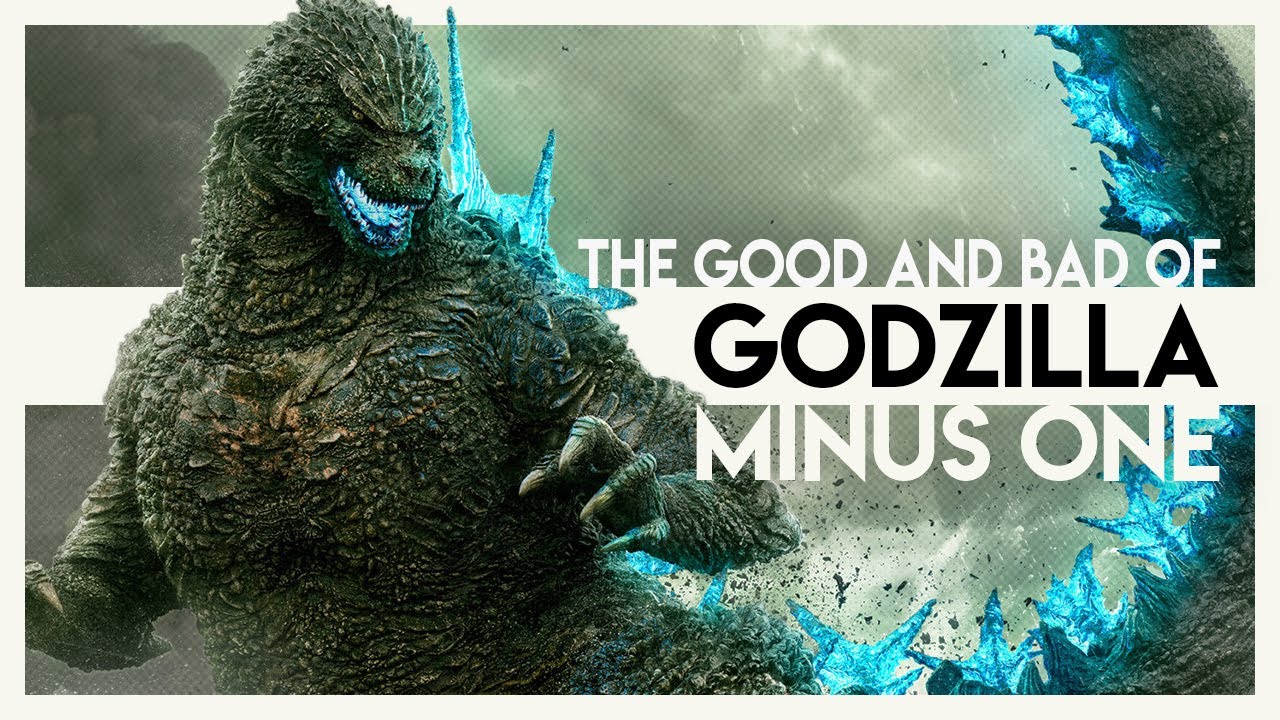
This is the third time we are covering a film from director Takashi Yamazaki, who previously directed Stand By Me Doraemon and Lupin III: The First. Dude’s quickly becoming one of my favorite directors. Anyway, this video is sponsored by Squarespace.
Ah, yes, Godzilla Minus One. Now that the hype has settled, I can finally talk about it with clear eyes. Don’t worry. I didn’t dislike it like I did with Shin. In fact, Minus One is up there as one of my favorites, all thanks to its well-written characters, including a vengeful, terrifying Godzilla. And that's what I want to talk about today: My thoughts on the depiction of Godzilla, how it affects the story themes, and share with you my one nitpick. Yes, I still have a nitpick. I know I'm becoming that one assh*le in the fandom. But hey, it's the job of a critic. Sit back and enjoy, this is the good and the bad of Godzilla Minus One.
[ Part One ] Set at the end of WWII, Godzilla Minus One follows Koichi, a Kamikaze pilot who ran away from his mission. Instead of sacrificing his life for his country, Koichi flies away to an island outpost, where he meets Tachibana, head of the mechanics team. Tachibana condemns Koichi's cowardice, hinting at one of the core themes of the movie. That night, Godzilla approaches. We are treated to one of the best scenes in Godzilla history. Oooh sh*t. Despite its modest budget, critics agree the film’s VFX blew Hollywood away. But few can explain why. It certainly isn't the realism. The effects look great, sure. But realism alone does not make it stand above others. What makes the VFX special, in my opinion, is the narrative intention behind it. As the saying goes: “It makes you want to believe.”
Traditionally, Godzilla acts like a natural disaster. In Destoroyah, his rampage through Hong Kong is not much of a rampage. He brings destruction by walking through it. Everything destroyed is collateral. In Shin Godzilla, He lashes out at everything like a typhoon with no specific targets in mind. Outside of combat situations, be it facing the military of another kaiju, Godzilla rarely acknowledges his surroundings. But the Minus One incarnation is different. Facing an encroaching monster, Tachibana orders Koichi to open fire with his aircraft machine gun. "But what if it only makes it angry?" "A 20-mm gun can kill anything!" As the audience, we all know this is an ineffective suicide attack. It mirrors the Kamikaze situation. Tachibana mirrors the mindset of the Japanese military, and Koichi represents the expendable soldiers. Let's keep that in mind for later.
Sitting inside the cockpit, Koichi hesitates, paralyzed by fear. Then... Godzilla looks at him. He perceives this world. That single glance tells us Godzilla is a thinking creature. We start to wonder, “What is he going to do?” And the answer is terrifying. He starts killing people. Not through collateral damage, but deliberate slaughter. It is the first time we see him with such a strong intention to cause harm. Later, during the Ginza attack, the first thing Godzilla does is target a train. Again, it’s not random destruction. He picks his target. There is effort behind his attack. He *acts* upon his malevolent intent, making his action personal. That sense of intent gives him a personality, and every move provokes an emotional reaction from us. We keep guessing his motives, and in doing so, we see him as alive.
Think about it: the often cited best CGI always comes from characters, be it T-1000 from Terminator 2, or Caesar from Planet of the Apes. Minus One achieves the same effect. There’s never a moment where Godzilla just exists. Every time he appears, it's either oh sh*t or oh f*ck. We become too caught up with Godzilla's character to scrutinize his appearance. And as we dig deeper into the story, we’ll see why giving Godzilla intent is so important.
[ Sponsor ] If you are a Kaiju, you're gonna need a website. Everybody only knows Godzilla. Why? Because he has Godzilla.com There ain't no Biollante.com! That's why every Kaiju should use Squarespace, the all-in-one platform for all your website creation needs. Whether you’re creating a portfolio for your powers, a blog documenting your rampage, or a fansite about yourself, Squarespace can help you. With award-winning templates, and tools to start from scratch, starting your site is just a few clicks away. The editing process is just as simple: type in your text like a text editor, upload your photos or videos, you can make your website just the way you want. Squarespace also offers tutorials on SEOs and analytics tools to help you boost your popularity. Don't forget to start a merch store, too! Start your free trial at squarespace.com/accentedcinema. Use the code ACCENTEDCINEMA for 10% off your first purchase. Don't let Godzilla hog the spotlight, show off your talent on your terms. Visit squarespace.com/accentedcinema, and start your website today!
[ Part Two ] As the sun rises, only Koichi and Tachibana remain. The rest of the mechanics are dead, all because Koichi couldn’t pull the trigger. At least, that’s what Tachibana believes. And deep down, so does Koichi. The war ends. And the story truly begins. Koichi returns to the ruins of Tokyo, wracked with survivor's guilt. "If you'd only done your job..." "My children wouldn't have died." Together with Noriko, whose parents died in the bombings, and Akiko, an orphaned baby, Koichi finds himself a makeshift family. Starting from zero, Koichi gradually rebuilds a life, as Tokyo rebuilds around him.
Despite the haunting nightmares every night, for a moment, happiness is within reach. "Daddy." "I told you. I'm not your father." But at every corner, Koichi pushes that happiness away. Haunted by his survivor's guilt, Koichi becomes self-destructive. "I'm someone... who wasn't supposed to live." And so, whatever he builds, he destroys. "Enough!" "I don't want that." Meanwhile, Japan is also healing. "Have you seen how fast Ginza is rebuilding?" Koichi builds his family, then topples it out of guilt. Japan rebuilds Ginza, and Godzilla burns it to the ground.
This is why the aforementioned character animation is so important. Godzilla's attack mirrors Koichi's psyche, which reflects the social mindset of post-war Japan. When we look at Godzilla, we are peering into the self-destructive side of Koichi. That also means the Kaiju story and the human story are one of the same. It’s why audiences said this is the first Godzilla film where they truly cared about the people. When asked why he never married Noriko, Koichi’s answer becomes the thesis of the film: "Because... my war isn't over yet." And thus, the second half of the film follows Japan’s fight to overcome Godzilla, and to overcome its national trauma. "This country has treated life far too cheaply." This is a common theme in Japanese media.
In Ruroni Kenshin, Kenshin spends the rest of his life helping people to atone for his endless sins. He, too, is self-destructive, willing to throw away his life to help. "The will to live... Your own life is worth as much as any other." It's only through rediscovering the will to live, can Japan rebuilds anew. "This next battle... is not one waged to the death." "But a battle to live for the future."
[ Part Three ] Unfortunately, this is where the film stumbles. Aw sh*t, here we go again. "Shut up." The problem lies in the final showdown, where Koichi proposed a Kamikaze attack on Godzilla. "I can kill it if I fly a plane full of explosives into its mouth." Seemingly moved by Koichi's courage, Tachibana decides to help him. "This was drawn by a girl named Akiko." "I want to protect her future." Also, Tachibana adds an ejection seat for him. "Live." And... I was groaning in the theater. Let's start from the beginning. Koichi’s survivor’s guilt came from failing *two* suicide attacks: Once, the actual plane attack; and the second time, on the island. The rest of the film is his redemption arc: Koichi finds happiness, overcomes his cowardice, and triumphs against Godzilla.
Meanwhile, Tachibana vanishes after Act 1, only to return unchanged, still furious that Koichi didn’t die for his country, still blaming him for everyone's death. Then he learns Koichi’s new plan. Apparently, his willingness to die is why Tachibana tells him to live. "Did I miss a page?" No, seriously, did I? Because it feels like something’s missing. Think about it, the film is overtly against throwing your life away. By that logic, Tachibana, who ordered an ineffective suicide attack, should be the one who needs a redemption arc. But he never got one. Now, I don't know if Tachibana installed the seat or if it's always been there, But narratively, it would have been so much better if Koichi is the one to ask for an ejection seat.
In this scenario, Koichi is brave, but not willing to throw his life away. Tachibana refuses, still calling him a coward. Koichi replies, “I have a daughter now.” Tachibana says, “The mechanics were my family." "And they died because of you.” Then, Tachibana sees Koichi with Akiko and realizes she’s an orphan he adopted. That’s when it clicks for him: life has value beyond duty. He changes, helps Koichi. Both characters complete their character arcs. But because there is no such scene, the narrative becomes that of Koichi earning Tachibana's approval... by expressing a willingness to die. What kind of f*ck up lesson is that? The movie spends two hours criticizing the military’s disregard for life, only to imply death is a path to redemption!
I mean, I guess Tachibana does learn the lesson. That's why he tells Koichi to live. But this whole transformation happens *off-screen*. One of the morals of the story... happens *off screen*!! You were this close to perfection. What in Godzilla’s name was that?
[ Afterword ] Of course, this doesn't affect my enjoyment of the film. Like I said, it was just a nitpick. Unlike Shin Godzilla, where a cohesive vision strengthens an unintentional message, Minus One merely has a small inconsistency that undermines a strong theme. Before we wrap this up, let's also address the film's political message. Whether you see Godzilla as a symbol of post-war guilt, or a classic symbol of American nuclear power, the film's tone is the same. Japan is shown acting in self-defense. It makes no mention of the Japanese aggression in Asia, nor the reason it was at war with the US. International reactions ranged from disappointment to condemnation. It's all par for the course for director Takashi Yamazaki, whose previous anti-war messages were either half-baked or controversial. I supposed that's a topic for another time.
I, too, would prefer a stronger anti-war stance. But given Japan’s current political climate, Minus One is, sadly, about as much as I expect. Like many Japanese anti-war films, Minus One makes amends to Japanese countrymen. And that is okay. But now that Godzilla is defeated, and the trauma confronted, I hope Japan can find the courage to finally face its imperialist past. After all, we all have our Kaiju. And for many people, Japan is our Godzilla.