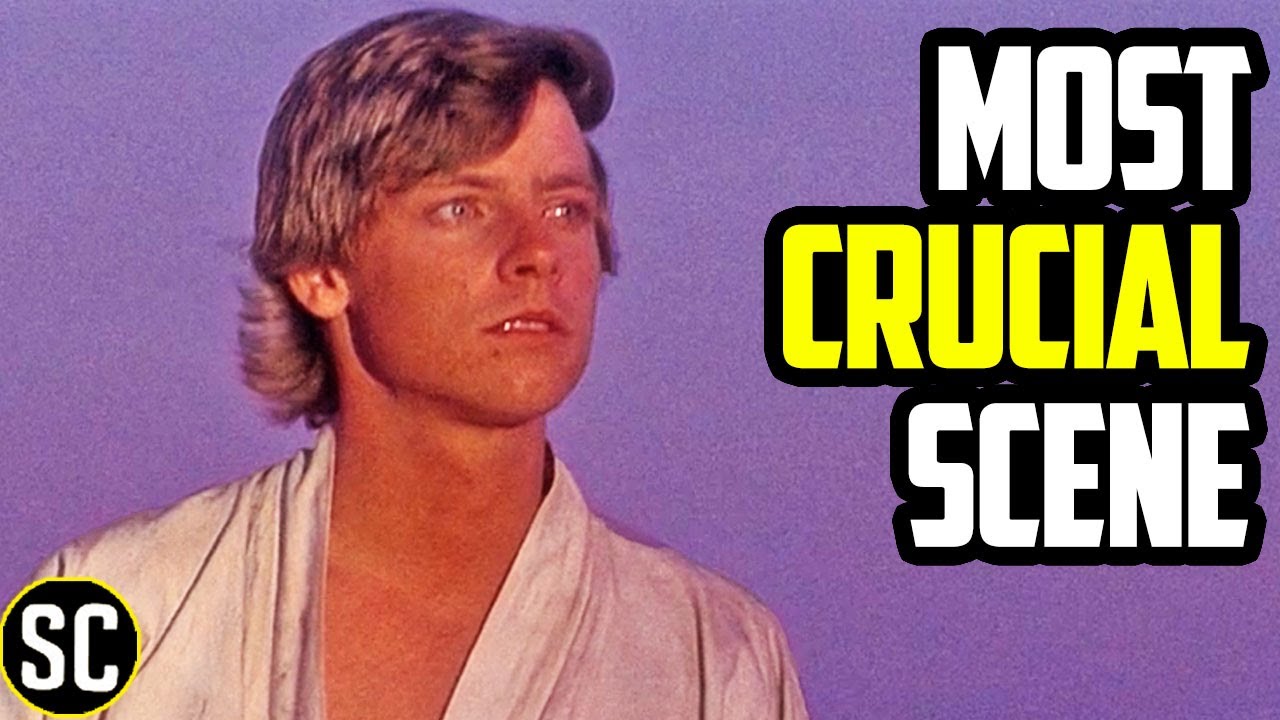
This is my favorite scene in Star Wars. And without this scene in Star Wars Episode 4, A New Hope, I don't think this saga exists. This is the most crucial scene in Star Wars. Welcome back, Screen Crush. I'm Ryan Ary, and let me explain why I think this is the most crucial scene in the Star Wars saga. First, let me explain what I mean by a crucial scene. Now, obviously, this is not the most crucial plot point in the entire Star Wars galaxy. In fact, the whole saga actually hinges on Anakin's turn to the dark side. And I'm sure I'll make a video about that later on. But it's hard to remember that when this movie first came out, it was not a franchise. It was just a movie called Star Wars. And it's fun because it combines so many of our favorite types of movies into one film and gives us a relatable protagonist. And I think it's this scene that actually sold the audience on Luke Skywalker.
Now, this scene has been replicated in some way or another in at least four other Star Wars films. And it's been replicated so much because it's a powerful moment that actually encapsulates the entire saga. But to fully explain why this scene is effective, I have to explain George Lucas and kind of where America was at at this point in time. That's because Star Wars isn't just popular because it's a good movie. It became the biggest movie of all time because it resonated with people on a deeper level. So George Lucas was an introverted kid who loved reading comics and sci-fi. And as a teenager, he loved souping up cars and driving really fast. And as a kid, he was constantly looking for older mentor figures, which is probably why he created the master Padawan relationship for the Jedi Knights instead of like having them train in a group.
But the reason young George Lucas needed a mentor is because he didn't get along with his dad. See, he grew up in the 1960s when parents and kids were famously arguing over the dinner table about topics like the Vietnam War, the civil rights movement, or how long your hair is getting. There was a cultural and generational shift happening in the 1960s. And the first front in that culture war was at home. George's dad, George Senior, was a very practical person. He ran a successful office supply store in their small city in Modesto, California. And he expected Junior to follow in his footsteps. And if this sounds familiar, it's because Lucas also copied their relationship with the bickering between Indiana Jones and his dad.
I'm bringing this up so you understand that anytime George Lucas makes anything, it's always personal for him. George obviously refused to go into his dad's business and instead enrolled in film school where he made a name for himself as a groundbreaking editor who made experimental art films. After graduating, he entered a mentor-mentee relationship with Francis Ford Coppola. Now Coppola's new studio, American Zoetrope, financed Lucas's first feature, THX1138. Now, this is a movie that is so weird and so sterile that it was a flop big enough to kill Coppola's new studio just as it was getting started. It's a story that, like Star Wars, is about escaping control. Only in THX's case, it's about escaping the control of oppressive robots and drugs.
After this movie, Lucas's wife, the great editor Marcia Lucas, encouraged him to tell a personal story, which he did with American Graffiti. That film is about four aspects of Lucas's personality cruising around town in a single night. And again, the main theme was escape. Escape from childhood, from expectations, from your hometown, and even escape by driving really fast. The movie even ends with a car crash like the one that nearly killed George Lucas when he was a teenager. Now, following that huge success of American Graffiti, he decided to make Star Wars, which is another incredibly personal story. If it weren't for all the space and stuff, I would say that it's a straight-up autobiography of George's life.
So, now let's look at the scene in question. At this point in the film, we have seen that there is a giant war being waged far away, just like how Vietnam was raging when George Lucas was growing up. Originally, Luke was introduced watching the space battle at a teen's local hangout when his best friend, a soldier, comes home from the war. And then he announces a big change. "We're going to jump ship and join the Alliance." The rebellion. This is akin to a friend who is a soldier in Vietnam coming home and telling his buddy that he's going to go AWOL, which actually happened frequently during the war.
When Star Wars was released, Vietnam had ended just two years before. It was very much on everyone's mind. And Luke was like most Americans. He was a young person who was hearing about the war, but it was very far removed from his everyday life. Luke is young and idealistic, and like a lot of young people in America at the time, he was chafing under his parents' control. And this brings us to the setup of the crucial scene. The Lars family has just sat down for a nice meal of blue milk, and Luke tells them that R2 might be stolen. And then Owen replies, "He died about the same time as your father." And Luke is suddenly seeing the potential for adventure, the potential for release from this sad, boring life. "He knew my father," he says.
And then Owen just shuts him down. "I told you to forget it." And then he sharply makes Luke remember his duties, "In the morning, I want them up there on the South Ridge working on those condensers." Now Luke though has already seen his opportunity to break free. He starts kind of hinting around like Ralphie in a Christmas story, laying the groundwork for getting a BB gun. And then like Ralphie, this leads up to his big ask. "And if these new droids do work out, I want to transmit my application to the academy this year." And I think you can see this being the exact same conversation that George Lucas had with his dad. Just replaced, you know, the harvest with selling stationery.
We have a tact father figure who doesn't want a kid to see the world. And worse yet, he wants to keep the kid trapped in the boring family business. And then they start bargaining. "But it's a whole another year. Look, it's only one more season." And then Luke storms off.
And then finally, we get to the most crucial scene in the Star Wars saga, the binary sunset. A scene I love so much, I have this collectible figure. It's the only one I own. So, George Lucas is known for writing clunky dialogue. Harrison Ford even said that he told Lucas on set, "You can type this stuff, but you can't say it." And Mark Hamill famously talked about a monologue that he begged Lucas to cut.
Lucas was always better with visuals. For instance, there's not a single relatable character in THX1138. But Star Wars is always remembered for its big action climax. But this scene is where Lucas really lets the visuals handle all of the emotional work of a scene. The character is not telling us how he feels. Lucas is showing us how he feels. So, in this moment, Lucas widely recognizes the power of stillness. He surrenders the narrative to John Williams. The score in this scene begins with a French horn solo as Luke first steps up to the horizon. The instrument is alone, and so is Luke. Not just physically, but emotionally. He has no one in his life that he can talk to, no one who understands the real him.
And we've all felt this way at some point in our lives, especially when we're kids, when we're trapped in that adult world where we have no control. And as far as we know, the only people Luke has in his life are his aunt and his tact uncle. So, the wide shot lasts for about 10 seconds as this light motif finishes. And then we cut to a closeup, but then we cut to the twin suns. And this is a brilliant bit of world-building. And we've all done this, taking a quiet moment for ourselves in nature where you just need a second to think about who you are or where you want to be. And the twin suns are also telling us, hey, this isn't Earth. This is some other world. But because we relate to the emotion of the moment, it really does feel like we are on an alien planet watching a strange twin sunset.
But then just a few frames before the cut to Luke, the full orchestra joins the solo. It's subtle, but this is sending a message. We began watching Luke Skywalker feeling alone, but by the end, we all have joined in with him. We are all watching this sunset, and we're all feeling this dream that we could be somewhere else far away. I mean, for such a crowd-pleasing film, this is a very downbeat scene. And we end the scene just on Luke, and we feel his loneliness and his longing for adventure.
This scene does hit right about at the midpoint of act one. The first act of the film ends when Uncle Owen and Aaru are killed and Luke finds their crispy dead bodies. Now, the shot of him looking at his destroyed home is pulled from the John Ford classic, The Searchers. But that scene also serves as a thematic ending to this binary sunset. First, we see that Luke dreams of going somewhere else. That is his heart's desire. And then his dream comes true, but at a terrible price.
If this scene didn't exist, I don't think Luke Skywalker becomes somebody that we care so deeply about. I think he's the hero of the movie. You know, he rescues the princess, saves the day, blows up the Death Star, but he's not going to be somebody that we really care about decades later. And if we don't care about Luke Skywalker's journey in this movie, then I'm not sure if the saga captures our imagination in quite the same way.
The score to the binary sunset becomes the definitive theme of Star Wars. It’s even brought back at the end of the film, re-imagined as a march. And that means that, hey, we can all be heroes, too. But all of that empathy starts right here when we are all watching a sunset on another world and looking for our place in the universe.
Well, guys, that’s just my thoughts on the most crucial scene in Star Wars. Do you like this scene? Let me know in the comments below or at me on Twitter, Blue Sky Threads, or on our free to join Discord server. And if it’s your first time here, welcome to the channel. Please subscribe. Smash that bell for alerts for Screen Crush. I'm Ryan Ery.