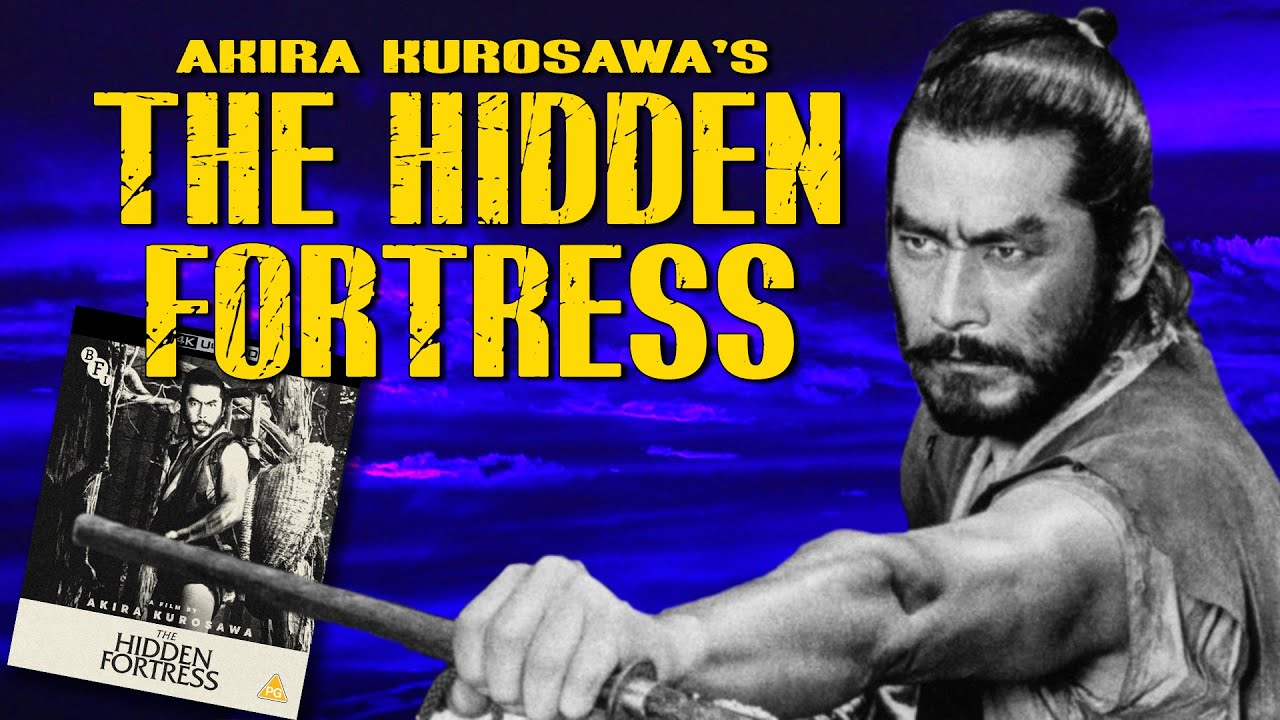
Welcome back to Dark Corners Physical Media reviews. We’re looking at another 4K Kurosawa boxset from the BFI, The Hidden Fortress. On its release, The Hidden Fortress was not as well received in the west as some other Kurosawa films but its reputation has grown through the years, at least partly due to its influence on another film.
‘You’ll be malfunctioning within a day you near sited scrap pile.’ ‘And let me catch following begging for help, because you won’t get it.’ The characters of Tahei and Matashichi, two peasants caught up in a war, served as inspiration for C3PO and R2D2 and for the first twenty to 30 minutes of Kurosawa’s film events are similar, 'Matashici! Is it you Matashici?' 'R2D2 it is you! It is you!' after which they do diverge, despite the presence of a Princess in need of help and duels between old warriors.
Although I would like to point out that there’s also an interesting comparison to be made with Kurosawa’s first samurai film, Those Who Tread on The Tiger’s Tail a similar story done on a much smaller scale. Probably Kurosawa’s most light-hearted film – alongside Sanjuro, which we have also reviewed – The Hidden Fortress boasts action, humour, a hidden treasure. ‘Sleep tight and let’s dream of mountains of gold.’ and even a musical number. Yet from its opening the film has a preoccupation with death. 'First the war ended.' 'Then as we were losers, we were forced to bury the dead.' Both as a subject of discussion and a reality.
16 year old Princess Yuki does not understand why other people should die for her. 'She was my age, sixteen, her life was just as precious as mine.' Very laudable, but she also does not understand that her attitude suggests they died for nothing. There is an overarching theme on the value of life, the two peasants are best of friends, yet forever falling out over the gold 'I picked it up. I found the gold.' and risking their lives for it. The character of samurai general Rokurota sees Toshiro Mifune at his most controlled. 'The enemy is less vigilant now. This is our chance to escape.' The wild outbursts that Kurosawa loved, taken care of by Misa Uehara in her film debut. 'I can't stand it! I Can't' You could argue – and I have done in our Patreon exclusive series about Kurosawa – that Yuki is the traditional Mifune role. 'Get away from me, you stink.'
But acting honours go to Minoru Chiaki and Kamatari Fujiwara as Tahei and Matashichi. 'Matashichi, let be kind to each other in the next life.' Chiaki was a Kurosawa regular – one of the 7 Samurai and the Banquo character, Miki, in Throne of Blood. Similarly though Fujiwara had less prominent roles he appeared in almost every Kurosawa film between 1952’s Ikiru and 1980’s Kagemusha. Both actors seize the opportunity making us follow a pair of characters whose behaviour is not always sympathetic. Kurosawa is perhaps the best example of the back and forth influence in film and that’s reflected in the extras on this package.
In commentary Tony Rayns talks about the influence on Kurosawa of John Ford and particularly 1926’s Three Bad Men – the Japanese title of Hidden Fortress translates as The 3 Villains of the Hidden Fortress. But there’s also George Lucas talking about Kurosawa’s film’s influence on him. Likewise in the accompanying booklet there’s essays looking at both sides, as well as Sight and Sounds’ somewhat sniffy original review. Elsewhere, Rayns commentary while interesting does get thinner as the movie goes on and occasionally falls back on describing what’s on screen. But we get another episode of Its Wonderful To Create, the documentary TV series about all Kurosawa’s films – as ever a wealth of information and behind the scenes images.
I do think the critical community still resents a film that they never much liked becoming so influential and loved but any dismissiveness is balanced out by the inclusion Steven Berkoff’s incredibly passionate introduction at the BFI for his screen epiphany. 'It combined everything I believed in. It had drama and it had movement. It had style and it had ideas.' The Hidden Fortress cannot stand with the absolute best of Kurosawa, but it does what Kurosawa did best; thought provoking whilst it entertains. Kurosawa seems to do this so effortlessly that we forget how hard it must be to make a meditation on death and social inequality that’s also a cracking adventure story.
Thanks for watching. Please like and subscribe. Star Wars certainly helped western audiences rediscover this film, what other movies got greater recognition thanks to a more recent film? Let us know in the comments below.