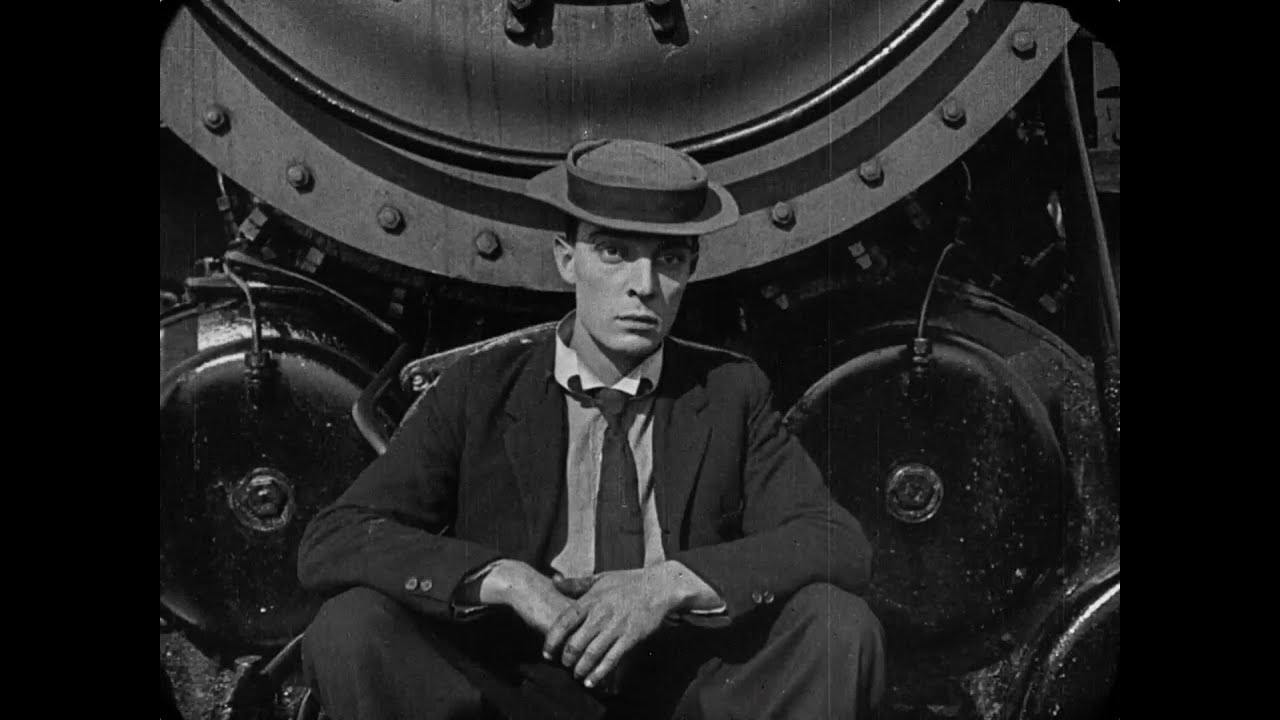
Hi, my name is Tony, and this is Every Frame a Painting. There are some filmmakers who are so influential that no matter where you look, you see traces of them everywhere. I see this filmmaker's framing in the works of Wes Anderson, his acrobatics and stunts in Jackie Chan, and his deadpan posture in Bill Murray. He, of course, is Buster Keaton, one of the three great silent comedians, often considered the greatest of all clowns in cinema history.
Nearly a hundred years later, Buster Keaton still has plenty to teach us about visual comedy. So, let's take a look at how this master builds a gag.
The first thing to know about visual comedy is to tell your story through action. Keaton was a visual storyteller who avoided title cards, focusing instead on gesture and pantomime. In his films, everything you need to know is conveyed through the actors' body language and their interaction with props.
Keaton believed that each gesture should be unique, each fall an opportunity for creativity. He also focused on where to place the camera, as visual gags typically work best from one particular angle. Changing the angle can change the gag, so finding the right angle was a matter of trial and error.
In Keaton's world, the visual plane was flat, governed by the principle that if the camera couldn't see it, neither could the characters. This allowed gags to make visual sense, even if not logically. Many of Keaton’s gags have roots in vaudeville and play like magic tricks, sharing the delight of trying to guess how they are done.
But beyond sight gags, Keaton mastered natural gags—those that emerge organically from character and situation. He allowed improvisation on set, claiming that about 50% of anything he shot was developed during filming.
Perhaps most notably, Keaton never faked a gag. He believed in convincing the audience by actually performing the stunts himself, without cutting. This authenticity is why his films remain vital nearly 100 years later, a testament to both his skill and integrity. Even today, when filmmakers attempt such feats, it reflects back on the originality with which Keaton approached his craft.
Keaton’s influence endures, even as many filmmakers pay homage to him—nothing quite matches experiencing the real thing.