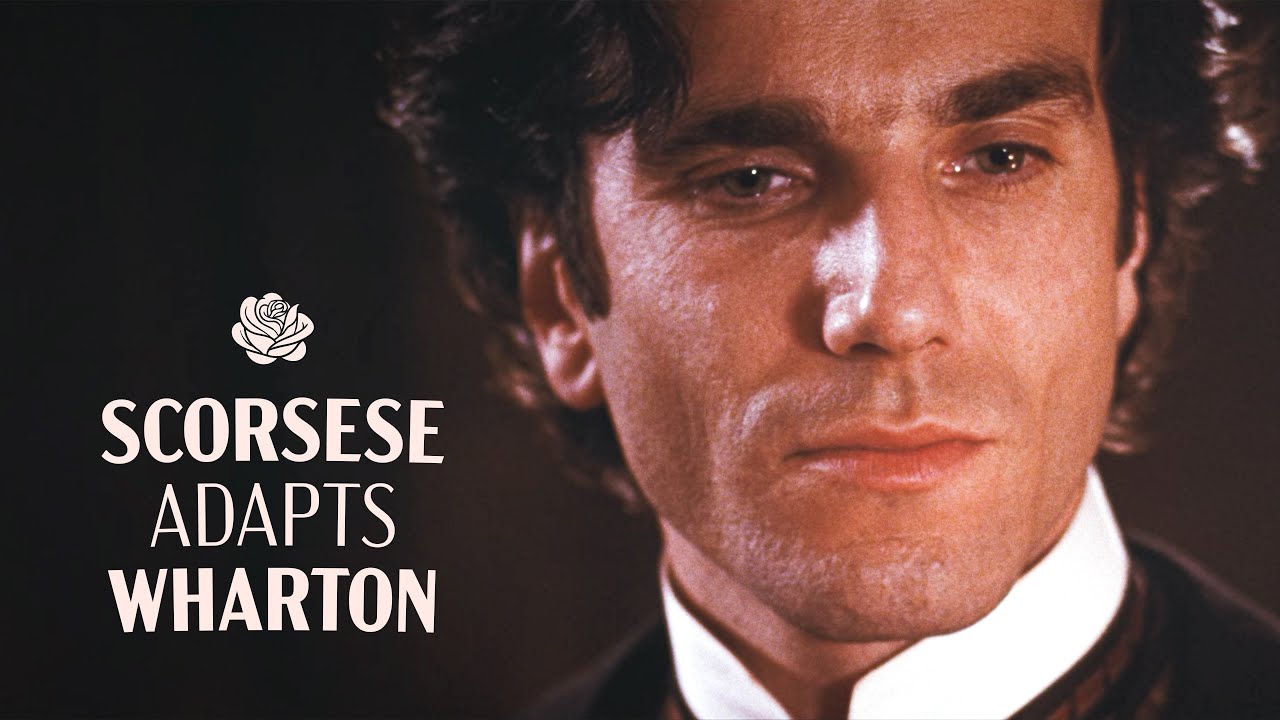
The first thing we see in Martin Scorsese's The Age of Innocence is an adaptation. It's Charlaguno's adaptation of Goethe's tragic play Faust into a grand opera. Goethe's Faust is one of the most esteemed works in the history of literature, and Gounod's version was for the better part of a century the world's most popular opera. But these two things are not the same. In his adaptation, Gounod changed Faust radically, simplifying and removing most of its deep metaphysical ruminations to focus on the tragic love story between Dr. Faust, an old philosopher made young and powerful by selling his soul to the devil, and Margarite, the virginal maiden he seduces, then abandons. Gounod supplanted the intellectual with the emotional. In other words, he made an opera. And big emotion is what opera does best.
In every adaptation across artistic mediums, there is a loss. You lose something of the original, something vital, but hopefully you gain something too—ideally something that the new medium is uniquely good at expressing. Scorsese's The Age of Innocence from 1993 is of course an adaptation of Edith Wharton's 1920 novel of the same name, and it too loses important elements of the original, things that lovers of the book like myself are sad to miss. But it also gains quite a bit, and what it gains is uniquely filmic. In certain ways, Scorsese's film is to Wharton's novel as Gounod's opera is to Goethe's play.
One way to imagine adapting a novel into a film is as a process of setting words to music. That's literally true in the case of soundtracks and musical scores. But it's also true in a deeper sense. The cinematic form has a rhythmic, melodious, emotionally charged quality that resembles the power of music. And the great directors have tapped into this quality with lighting, editing, blocking, camera movement, or in the case of Martin Scorsese, all of the above.
Consider this opening scene. In the novel, the narrator describes the opera while ironically commenting on all the absurd rules and protocols of the rich society assembled to watch it. Then she focuses in on Newland Archer. The narrator shows us Newland's thoughts as he watches this seduction of Margarite by Faust and then looks across the house at his soon-to-be-fiancée May Welland, a young woman who he believes to be as pure and naive as the young woman in the show. The darling, Archer thinks she doesn't even guess what it's all about. May is just too pure and too ignorant to understand the seduction for what it is.
In Scorsese's version of the opening scene, we get the same action but lose that wry, biting commentary on Newland and his society. We lose the ironic distance of the narrator. Scorsese does bring that narrator in briefly at the end of the scene, but for the first five minutes, he plunges us into the world of 1870s New York into the now long demolished Academy of Music among the city's old money elite. As Francis San Marcello says, the movie sets a different tone from the book to trigger identification with the characters and produce emotion instead of underscoring the role of conventions. Wharton immediately undercuts Gounod's opera. Scorsese lets us feel it.
The whole first scene is operatic in its construction. Michael Ballhaus's camera swoops around the house using every camera move imaginable: pans, tilts, tracks, dollies, cranes, shots that combine all of these things. Scorsese even invented a new technique to simulate what it's like to look through opera glasses. This 6-minute scene has 54 shots, and 34 of them have camera movement of some kind. In terms of duration, that's over 80% movement. Basically, the scene is a dance designed to enchant the viewer. In the novel, you of course can't hear the opera music. The film, on the other hand, uses that music to achieve the same effect that Gounod achieved—a heightening of emotion. And that emotion infuses the characters as well as us.
Both Wharton's novel and Scorsese's film get us to think about how we as individuals relate to the web of our social world. Scorsese does it in a different way than Wharton because he has to. He's fully aware that a novel can't become a film without some loss. But he knows too and shows in The Age of Innocence that there's a lot to gain in adaptation.